
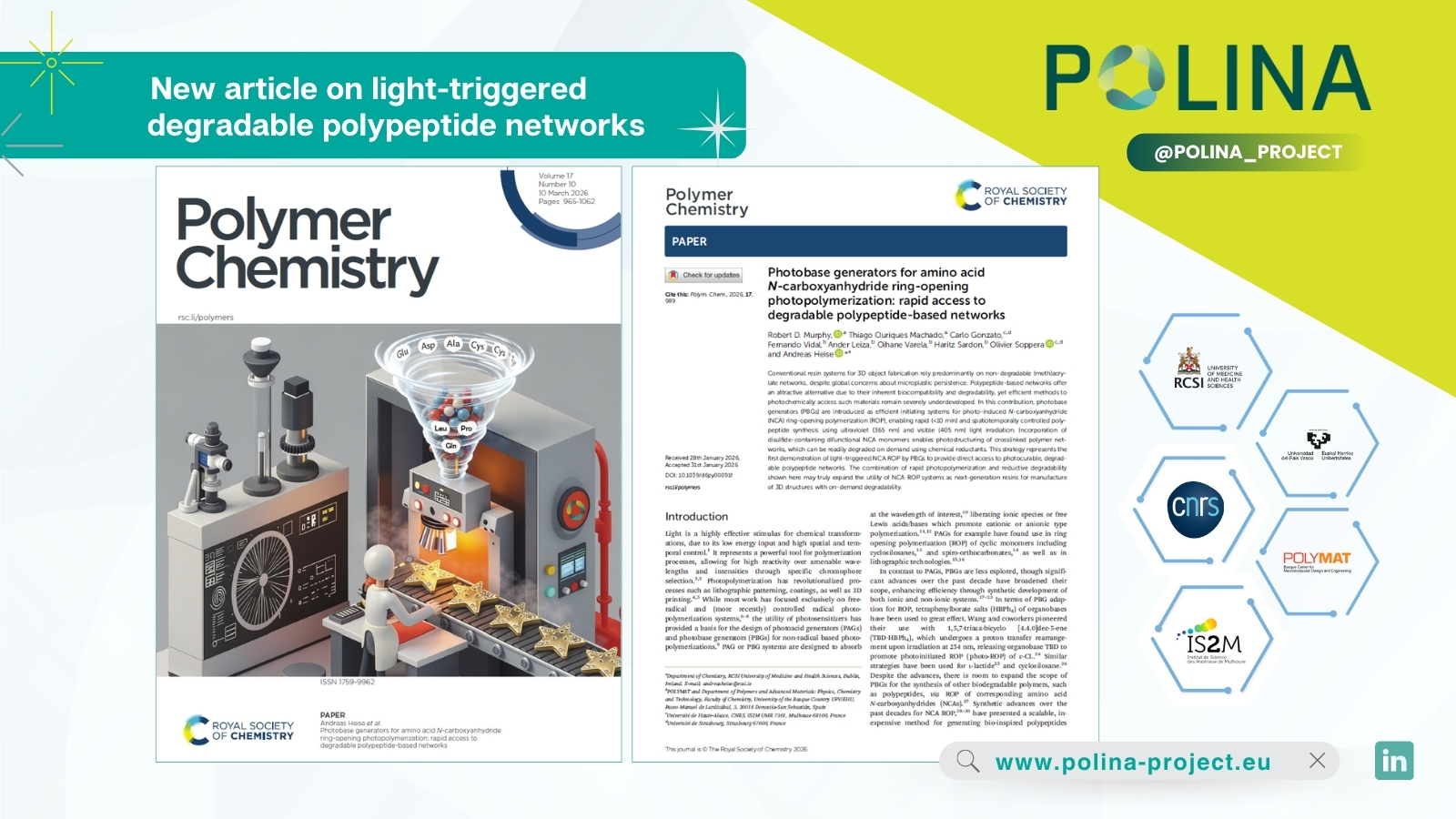
POLINA partners have published a new scientific article in the Royal Society of Chemistry journal Polymer Chemistry, presenting an innovative light-driven approach for producing degradable polypeptide materials with potential applications in advanced manufacturing and sustainable polymer systems.
News text
The study introduces a novel method based on photobase generators (PBGs) to initiate ring-opening photopolymerisation of amino acid N-carboxyanhydride monomers. This process enables rapid synthesis of well-defined polypeptides using ultraviolet or visible light, allowing precise spatial and temporal control of polymer formation.
Unlike conventional photopolymer resins, which are often based on non-degradable (meth)acrylate networks, the materials developed in this research form biocompatible and degradable polypeptide networks. The method enables fast polymerisation within minutes and provides access to crosslinked structures that can be degraded on demand through chemical reduction.
The work also demonstrates the fabrication of photostructured polymer networks and patterned shapes, highlighting the potential of this approach for applications in lithography, advanced materials design and additive manufacturing technologies.
Citation
Murphy, R. D., Machado, T. O., Gonzato, C., Vidal, F., Leiza, A., Varela, O., Sardon, H., Soppera, O., & Heise, A. (2026). Photobase generators for amino acid N-carboxyanhydride ring-opening photopolymerization: rapid access to degradable polypeptide-based networks. Polymer Chemistry, 17, 989–994.