
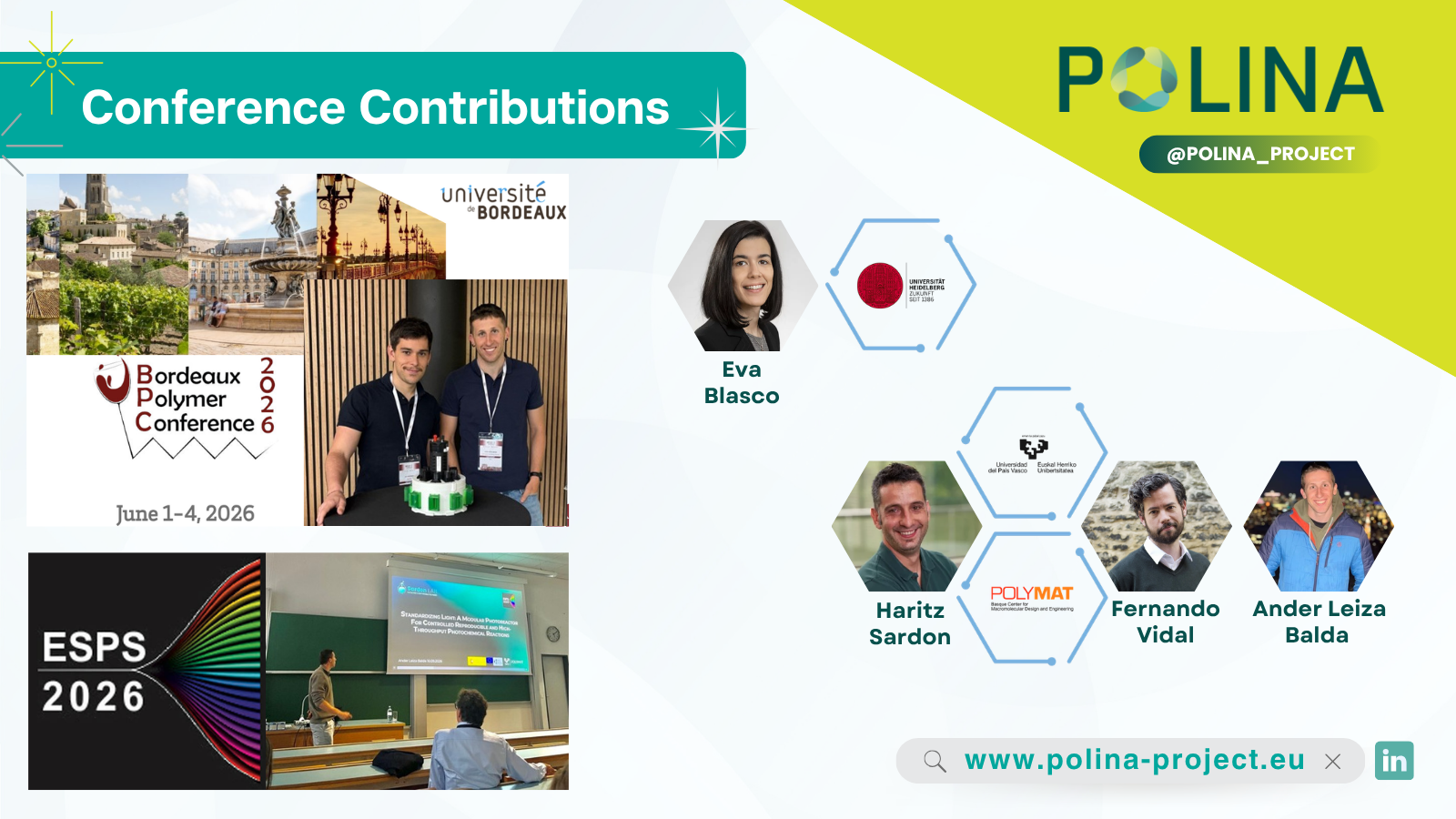
POLINA researchers have presented their work at two major European scientific conferences recently, contributing to discussions on sustainable polymers, photochemistry, advanced materials and high-resolution printing.
In June 2026, members of the POLINA consortium participated in the Bordeaux Polymer Conference 2026 (BPC 2026), held in Bordeaux from 1 to 4 June. The conference brought together researchers from across the international polymer science community to exchange knowledge on emerging developments in polymer chemistry, materials design and advanced applications.
Four researchers from the POLINA consortium delivered oral presentations during the conference.
On 2 June, Ander Leiza Balda (UPV/EHU-POLYMAT) presented “Standardizing light: a modular photoreactor for controlled reproducible and high-throughput photochemical reactions”. His work addresses the need for greater control and reproducibility in light-driven chemical processes, providing an approach to standardising irradiation conditions and supporting high-throughput photochemical experimentation.
Also on 2 June, Eva Blasco (Heidelberg University) presented “Engineering polymers for high-resolution 3D/4D printing”, highlighting advances in the design of polymeric materials for sophisticated additive manufacturing and photolithographic applications.
Fernando Vidal (UPV/EHU-POLYMAT) presented “Monomer design to advance on polymer functionality and material sustainability”, focusing on how molecular and monomer design can contribute to improved polymer performance while addressing sustainability considerations.
On 3 June, Haritz Sardon (UPV/EHU-POLYMAT) delivered the presentation “How to move towards Circular Plastic Economy: from Chemical Recycling of Commodity Plastics to Circular by Design Polymers”. The talk explored approaches to improving plastic circularity, ranging from chemical recycling strategies to the development of polymers designed with circularity in mind from the outset.
POLINA’s presence at BPC 2026 reflected several research areas relevant to the consortium, including sustainable polymer design, controlled photochemical processes and advanced 3D and 4D fabrication techniques. The conference also provided an opportunity for consortium researchers to exchange expertise with the wider polymer science community and discuss emerging approaches across related disciplines.
The dissemination of POLINA-related research continued in September at the 9th European Symposium of Photopolymer Science (ESPS 2026), held in Vienna from 7 to 11 September.
Ander Leiza Balda represented UPV/EHU-POLYMAT and the POLINA consortium at the symposium, where he once again presented his work on “Standardizing light: a modular photoreactor for controlled reproducible and high-throughput photochemical reactions”.
ESPS brings together academic and industrial researchers working in photopolymer science and related light-driven technologies. Ander’s participation offered an opportunity to discuss the development of reproducible photochemical methodologies with a specialised scientific audience and to exchange perspectives with researchers working at the forefront of photopolymerisation.
Participation in both BPC 2026 and ESPS 2026 supports POLINA’s wider communication and dissemination activities by connecting the consortium with relevant scientific communities across Europe. These exchanges are particularly valuable as POLINA advances the development of new light-responsive polymer systems and photolithographic approaches for future technological and biomedical applications.